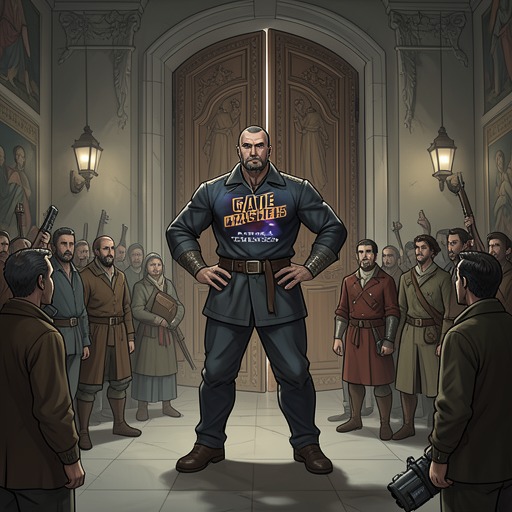
Humans escaped from Turemok patrol ship
Gate CrashersThe Turemok patrol cruiser breakout is the turning point at which the human expedition ceases to be a contained prisoner-transport incident and becomes an organized fight for survival, witnesses, and proof. The escape frees the humans from Turemok control, exposes Vel Noric’s death and J’quol’s manipulation, and leads directly to the retaking of the AEUS Magellan while the Turemok command prepares to erase the surviving evidence.
Captivity and the Stakes of Escape
The breakout occurs after the humans have been seized under suspicion of the geocides of Culpus-Alam and Okim. Turemok authority treats the prisoners as dangerous offenders: Zek’nel of the Turemok Pacification Force orders them to surrender their weapons and submit within twenty rakims, while the humans are already being processed as an armed threat rather than as explorers contesting a disastrous misunderstanding. That accusation rests on the larger history of the contact crisis. The buoys had been interpreted on Earth as a cage, and the “Human Wildlife Preserve” warning had provoked demands for a military deterrent; from the Turemok perspective, human technological acceleration and the destruction of Culpus-Alam and Okim have become grounds for immediate coercion. The danger is therefore both physical and legal. D’armic Ytol ev Shamel has declared his intention to bring Allison Ridgeway and her crew into custody for judgment, while the Assembly of Sentient Species has already authorized a punitive expedition against Earth even after new evidence begins to challenge the human prosecution. Escape is not merely a flight from confinement. It is the only available way to preserve witnesses and reach the ships before the Turemok command can turn a contested arrest into an unanswerable record of human guilt.
The Breakout and Vel Noric’s Death
The immediate reversal begins when the imprisoned humans overpower Vel Noric and his security complement. Kotal is informed that security has confirmed Vel Noric is dead, that the humans have escaped, and that they have already killed a hand of guards; the report also states that the prisoners recovered the weapons confiscated when they arrived. Their status changes in a single sequence from disarmed detainees to a mobile, armed force capable of seizing control of the cruiser’s internal spaces. The death of Vel Noric has a special consequence because he is not simply another guard. Noric has been tracking the human technological threat and has learned that Earth has opened its own high-space portal, a discovery that intensifies Turemok anxiety about humanity’s future power. His death removes a witness to the prisoners’ treatment and leaves the Turemok command with an urgent incentive to control the story. The escape thus creates a race between the humans’ need to expose what happened and J’quol’s need to make the disappearance look like a justified combat loss.
D’armic as Witness and Ally
Allison’s group finds D’armic barricaded behind a door during the firefight. Maximus Tiberius initially argues that there is no time to deal with someone hiding from them, but Allison refuses to abandon him. D’armic is the only witness to what happened at Okim and an officer of the Assembly of Sentient Species; keeping him alive is essential if the humans are to clear their names. This decision gives the escape a purpose beyond tactical survival. The humans need an alien witness whose testimony can challenge the official accusation of geocide. D’armic’s release also changes the emotional register of the operation. After Allison promises that the humans will not hurt him, the door opens and the small gray alien runs to her, throwing his oily arms around her waist and staining her already ruined uniform. The gesture is awkward, physical, and unexpectedly intimate. In a conflict structured by surveillance, custody, and mutual suspicion, D’armic’s embrace marks a fragile transfer of trust: the accused humans become his protectors, while he becomes the witness whose knowledge may protect them from execution and Earth’s destruction.
Retaking the AEUS Magellan
The escape from the patrol cruiser is followed by a coordinated effort to recover the captured human vessels. Kotal is only beginning to adjust to his new station when a proximity alarm announces that the humans have neutralized the hangar guard and escaped in their small craft. The understated Turemok response disguises the gravity of the development: the prisoners are no longer contained, and the ships that carry the physical evidence of the expedition are once again within human reach. Allison drops through a hole cut into the AEUS Magellan’s hull by the shuttle’s emergency docking laser. Thomas Harris and his squad secure the corridor ahead of her, and the plan is to sweep forward from engineering, where the crew is presumed to have been confined in the shuttle bays. The assault divides the available personnel between the two vessels: the AEUS Bucephalus already carries the remainder of the marine platoon and a full armory, while Jacqueline Dorsett is transferred to Maximus Tiberius to replace his fallen pilot. The operation is therefore both a boarding action and an improvised redistribution of people and equipment under pressure. Steven Billings has already prepared the decisive internal countermeasure. When Allison reaches him, he shows her a schematic of the AEUS Magellan and camera feeds tracking the Turemok boarding party. He has lured the intruders into position and activates a radiation control on the schematic, turning the ship’s own systems against its captors. His success allows him to tell Allison that the retaking has already been handled, converting what might have become a corridor-by-corridor massacre into a controlled recovery of the vessel.
J’quol’s Counterplot and the Larger Consequences
J’quol responds to the escape by proposing to destroy both human vessels. Kotal realizes the logic of the scheme: deaths among prisoners under Turemok custody would invite suspicion, and the human ships would constitute evidence for an Assembly inquiry. If, however, the prisoners are allowed to escape, attack a sabotaged patrol cruiser, and die in a supposedly necessary counterattack, J’quol can present the destruction as self-defense. The plan would eliminate both witnesses and physical evidence while making the humans appear responsible for the final violence. The breakout defeats containment but does not end the danger. It forces the humans to preserve D’armic, recover the AEUS Magellan, and expose the machinery behind the official account before J’quol can destroy it. Its consequences extend beyond the cruiser: the escape becomes part of the chain of events that carries the human case before the Assembly of Sentient Species, where D’armic’s testimony and new evidence can challenge the judgment already rendered against Earth. Yet the political response remains brutally irreversible. Even after the Assembly acknowledges that the new evidence must be investigated, the punitive armada sent against Earth cannot simply be halted because it was dispatched weeks earlier after the destruction of Kulla. The escape therefore wins the humans a chance to speak without immediately winning them safety. It changes captivity into agency, but it leaves an entire planet racing against an expedition already in motion.